
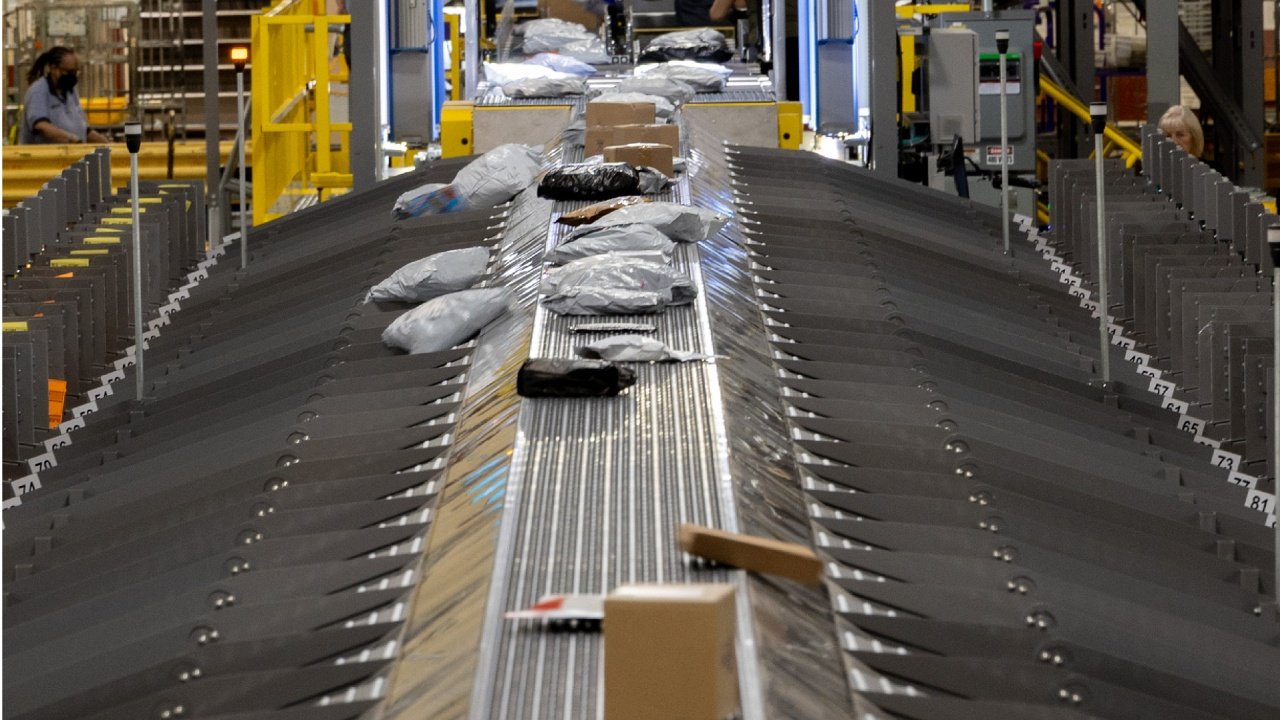
Eighty-eight million packages a day. That’s the volume the U.S. Postal Service can now process thanks to the most ambitious modernization in our history. In five years, we’ve rebuilt an aging, misaligned network — that at its best could handle 25 million packages a day — into a market leader that now delivers significantly more packages per operating day than our competitors.
Automation has powered much of this evolution. Since 2021, USPS has deliberately and systematically revamped its operations by deploying next-generation sorters that are faster, smarter and more reliable. They’re adaptable, too, to handle customer demands in an economy that is dependent on e-commerce to drive revenue.
Our focus on new technology is unwavering. In the past five years, USPS has installed more than 600 new sorters to replace obsolete machinery with modern, purpose-built systems. These new machines can handle larger boxes and higher volumes than legacy equipment and process them much faster. Just as importantly, they integrate seamlessly into our new hub-and-spoke model, powering the shift to a nationwide network that eventually will be anchored by 60 regional processing and distribution centers (RPDCs).
Automation isn’t just improving individual facilities; it’s enabling the foundation of a new, more competitive and higher-performing USPS.
The results are clear. Since the start of modernization efforts less than five years ago, we’ve more than tripled daily package capacity. The 88 million pieces mentioned above is a massive capacity increase of 63 million packages a day. And that means we can meet peak demand with on-time and reliable service without straining our system.
I’ve been around postal sorters for most of my career, and what excites me most about our new generation is their flexibility. Our new million-package-a-day matrix sorters at our RPDCs and regional transfer hubs are a prime example. Some, like the matrix regional sorter in New Jersey, are optimized for higher speed and volume, while others, like the matrix east/west sorter in Arizona, are engineered for lower maintenance. Some are even designed to be portable, which allows us to grow our network dynamically rather than relying on one-off machines.
Standardization is another key facet of this automation evolution. New parallel induct linear sorters and single induct linear sorters, although distinct, share common components, and both are built on the same technology as most non-matrix sorters deployed since 2021. This approach is a huge help in reducing spare parts inventory and streamlining employee training.
Importantly, every new USPS sorter, regardless of designation or size, can now handle packages up to 22 by 20 by 18 inches and 30 pounds, a great improvement over the much smaller, lighter and different sorting limitations of our older systems. This standardization boosts throughput and reduces manual handling, while also creating a consistency that makes the entire USPS network more adaptable and competitive.
While packages are central to our future, we haven’t forgotten about letters and flats. Today, we are also refurbishing existing letter and flat sorters, stripping them down and installing new parts to ensure they’re ready for modern mail processing. It’s like switching out the engine in a car: the outside may look the same, but the power inside is all new. This investment ensures that letters and flats will remain a reliable part of our service, integrated into the same improved network.
For employees, the modernization of our sorters brings relief. Greater automation reduces repetitive labor and the physical stress of lifting heavy boxes, allowing postal employees to focus on higher-value tasks. The deployment of small delivery unit sorters at sorting and distribution centers, for instance, automates much of the package processing that had to be done by hand at smaller delivery units. This doesn’t just improve efficiency; it reshapes how we serve customers by aligning our output with the strengths of our new network.
I am proud of what we’ve built over the past five years. Today, we have a network that handles millions more packages every day by deploying automation that improves both capacity and accuracy. These enhancements will continue to drive high performance and financial sustainability as core features of USPS operations. As we continue on this journey, our investment in technology and deployment of modern sorters will solidify USPS as a reliable shipper and partner for our customers.
Gary Reblin
Chief Technology Officer and Executive Vice President
This is all well and good, but the problem is somewhere down the line packages and mail get sat on by management. They, for whatever reason, just cannot seem to get the mail delivered in a timely and correct fashion. The public just cannot understand why a package goes across the state before it goes ten miles and the USPS, as usual, cannot explain it either.