
Background
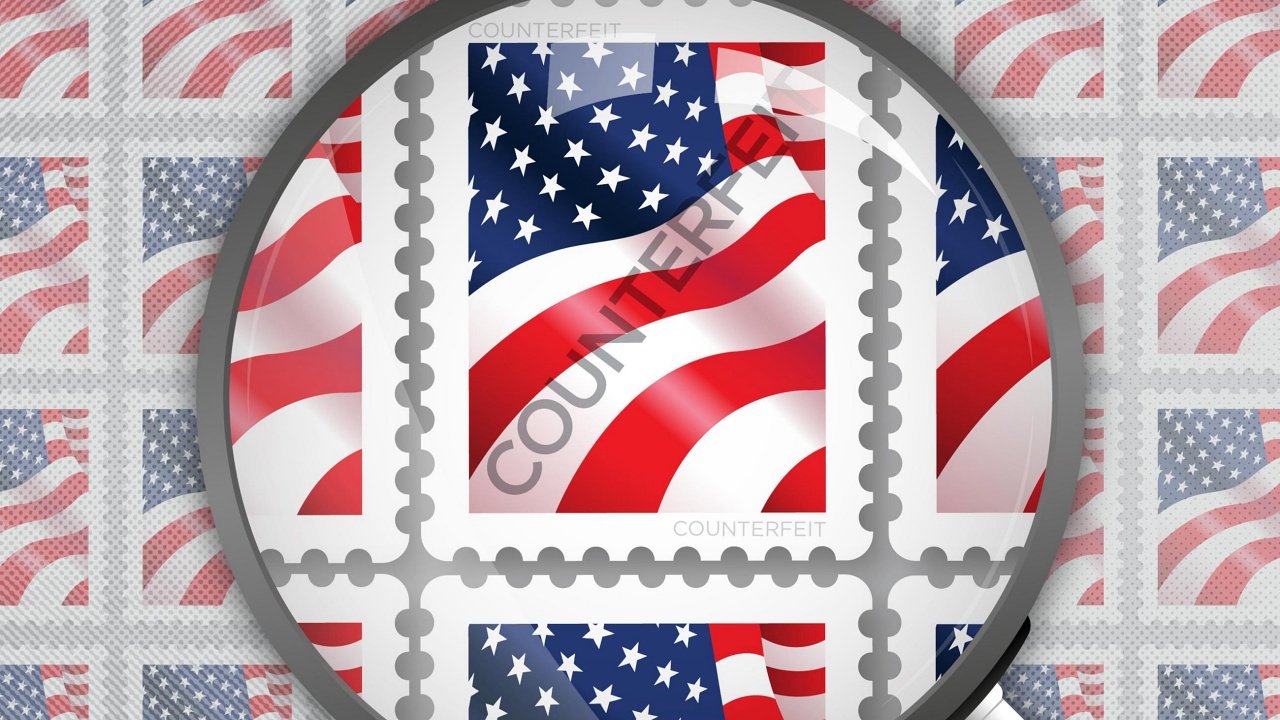
The U.S. Postal Service delivers over 108 billion pieces of mail annually, and each piece requires an approved stamp or other payment indicator. Bad actors, however, are increasingly selling, printing, or distributing counterfeit stamps. To combat this threat to its finances and customers, the Postal Service and its primary law enforcement arm, the U.S. Postal Inspection Service, focus on preventing counterfeit stamps from entering the mail system through public education, removing online fraud schemes, or partnering with other federal law enforcement to interdict illicit inbound shipments.
What We Did
Our objective was to evaluate the Postal Service and Postal Inspection Service’s efforts to mitigate the threat of counterfeit stamps. We reviewed related policies, initiatives, and data; engaged a contractor to assess online threats; and tested equipment.
What We Found
Postal Service and Postal Inspection Service mitigation efforts are limited, with no substantive approach to identify counterfeit stamps in the Postal Service network. While the Postal Service and the Postal Inspection Service have increased prevention-related efforts, the quantity of counterfeit stamps in the network remains unknown.
The Postal Service has not developed a comprehensive, risk-based strategy for identifying and mitigating counterfeit stamps. Developing such a strategy would help coordinate efforts across the organization, putting the Postal Service in a stronger position to protect its revenues and customers. The urgency of this threat also necessitates immediate actions to address other mitigation shortfalls. First, the Postal Service did not set mail processing equipment’s detection capabilities to a level to sufficiently detect counterfeit stamps or conduct sample testing to quantify the potential revenue loss. Second, the Postal Service has no identification capabilities across any other points of mail entry. We estimate these shortfalls resulted in over $349 million in revenue loss and $1.7 billion of revenue at risk in fiscal year 2026. Lastly, the Postal Service takes more than twice as long as comparable companies to disable online threats due to legal considerations.
Recommendations and Management’s Comments
We made four recommendations to address the issues identified in the report, and management agreed with all four. We consider management’s comments responsive, as corrective actions should resolve the issues. Management’s comments and our evaluation are at the end of each finding and recommendation.
“Although management has used the Lanham Act regularly to take legal action against bad actors that sell merchandise like t-shirts and hats using unauthorized Postal Service logos and trademarks, it has applied this approach less often to online sellers of counterfeit stamps, even when they misuse Postal Service logos.”
Anti-Union Morons.
The Postal Inspection Service wants to be taken seriously as the agency protecting the mail, but the OIG just exposed something remarkable: on counterfeit stamps, USPIS apparently does not know how many are in the network, does not have a comprehensive risk-based strategy, and is operating with mitigation efforts the OIG described as “limited.”
That would be bad enough if this were a minor issue. It is not.
The OIG estimated more than $349 million in revenue loss and $1.7 billion in revenue at risk in FY 2026. Meanwhile, from FY 2020 through FY 2025, the Inspection Service closed a grand total of 31 counterfeit stamp cases nationwide, identifying nearly $21 million in known losses.
Thirty-one cases. In six years.
So while counterfeit postage is potentially costing the Postal Service hundreds of millions of dollars, the agency responsible for protecting postal revenue has produced what amounts to a rounding error in enforcement activity.
This is the Inspection Service in a nutshell: press releases, task forces, acronyms, and after-the-fact explanations — but no real prevention, no real measurement, no real strategy, and no credible control over the threat.
At some point, “resource limitations” stops being an excuse and starts becoming a confession.
If USPS is losing billions, mail volume is declining, delivery points are increasing, and counterfeit postage is bleeding revenue from the system, maybe the first step is admitting the obvious: the Postal Inspection Service is not managing the threat. It is watching it happen.