

Washington, D.C. – Today, the Postal Regulatory Commission (Commission) released its annual Financial Analysis report, which examines the Postal Service’s finances for fiscal year 2025 (FY 2025) using well-known financial metrics. This analysis provides greater clarity, transparency, and accountability of the Postal Service’s financial data and trends. At the end of FY 2025, the Postal Service’s financial position reflected continued net losses and a large net deficit.
In FY 2025, the Postal Service recorded a net loss from operations of $2.7 billion. Compared to FY 2024, the increase of $0.9 billion in net loss from operations was the result of a $1.8 billion increase in operating expenses, partially offset by an increase of $1 billion in revenue. The increase in operating expenses occurred despite total volume decreasing by 3.7 percent, including a 3.2 percent decrease in the volume of Market Dominant products. The disconnect between workload and costs also resulted in a 2.1 percent decrease in Total Factor Productivity, marking the ninth decline in the last ten years. Despite decreases in volume, operating revenue increased by 1.3 percent. Market Dominant product prices, such as First-Class Mail, increased by approximately 15.2 percent between July 2024 and the end of FY 2025.
When Non-operating Expenses are included, the net operating loss of $2.7 billion results in a net loss of approximately $9 billion. This is an improvement of $0.5 billion compared to FY 2024. However, losses sustained over the past 10 years have weakened the Postal Service’s financial position, resulting in a significant gap between assets and liabilities. At the end of FY 2025, the Postal Service recorded total assets of $41.7 billion and total liabilities of $83.3 billion.
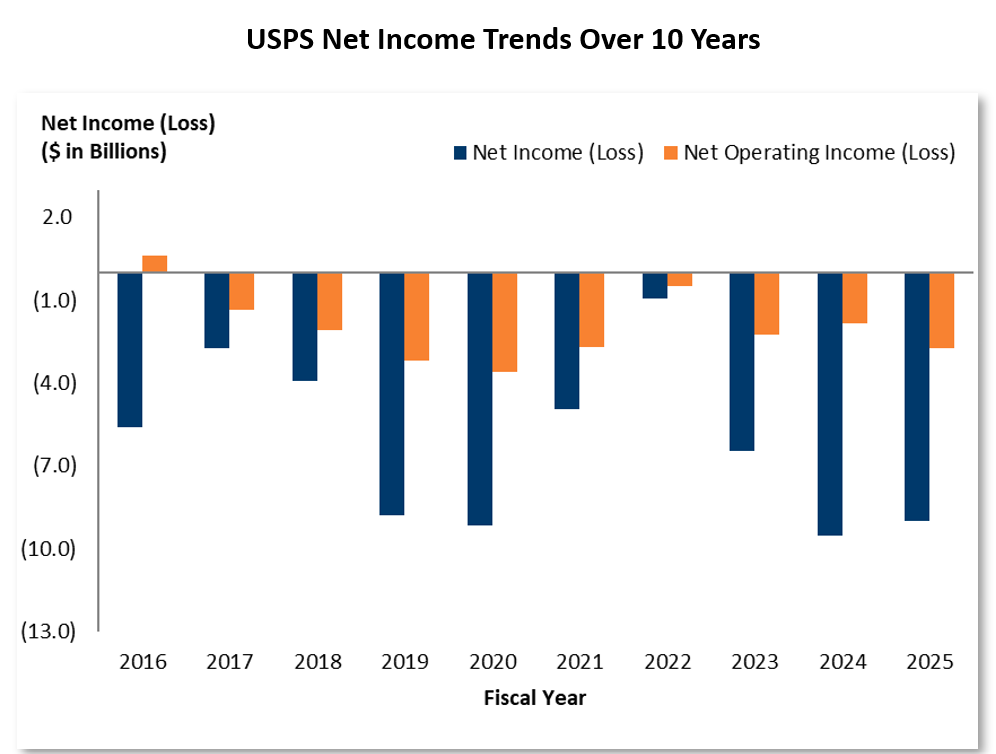
A summary of the primary contributors to the Postal Service’s financial condition includes:
-
Total net losses of $9 billion.
-
The net deficit was $41.6 billion, consisting of an accumulated deficit of $57.7 billion offset by capital contributions of $16.1 billion, the highest level of capital contributions since passage of the Postal Accountability Enhancement Act.
-
In FY 2025, the Postal Service had more cash on hand than the year before, but it had much less in short-term investments, and it stayed at its full $15 billion borrowing limit without paying any of that debt down. Overall, it had less total liquidity available to cover its short-term debt than it did the year before and less than its average over the past decade.
-
Operating revenue rose to about $80.6 billion, an increase of roughly $1 billion (1.2 percent), driven by USPS Ground Advantage growth and price increases across mail and shipping.
-
Total operating expenses stood at $83.5 billion, which was $1.7 billion higher in FY 2025 than the prior year, and $0.1 billion more than the Integrated Financial Plan.
-
Highway transportation costs went up slightly in 2025, by about 1 percent, after dropping more than 8 percent the year before, because the Postal Service relied more on flexible, but generally more expensive freight auction trips. At the same time, air transportation costs fell by almost 18 percent because more packages were shifted from planes to trucks, which are usually cheaper for many routes. Total operating expenses ended up higher than the Postal Service had planned because compensation and transportation costs were higher than expected. Pay and benefits alone were $0.4 billion higher than planned, primarily because inflation pushed up cost-of-living adjustments for employees.
-
Almost 70 percent of the Postal Service’s expenses are for employee pay and benefits. In FY 2025, it used 5 million more hours of overtime, but 12 million fewer total workhours and had 15,000 fewer employees than the year before.
-
The career workforce declined for the first time since FY 2020, with a decrease of approximately 2,400 employees. The non-career workforce declined by approximately 18,000 employees. Compared with FY 2020, it now has about 35,000 more career employees and about 55,000 fewer non-career employees.
-
Although recent reductions in workhours and total headcount have moderated the pace of cost growth, factors such as higher benefit costs, increased career conversions, and volatility in overtime workhour usage continue to exert upward pressure on compensation expenses.
This analysis meets the Commission’s financial reporting responsibilities and responds to the continued interest from policymakers and stakeholders in the Postal Service’s financial health. A complete copy of the Financial Analysis report may be viewed at www.prc.gov.
The devil is in the details. The detail that is troubling is the reference to number of employees, which has declined, but the number of managers and EAS employees has actually increased significantly. Any amount is significant because volume has declined year over year. Carriers in every corner of the country hear it from their bosses every day, “you don’t have any mail.” “We’re losing money.” So the question is, why are they hiring more and more managers that don’t facilitate delivering or moving the mail?
We had 10 people out on safety stalking carriers this week.
All PMs and Supes with no jobs in their own offices.
Remember They are not your friends. Stop pretending they
are!!!!