
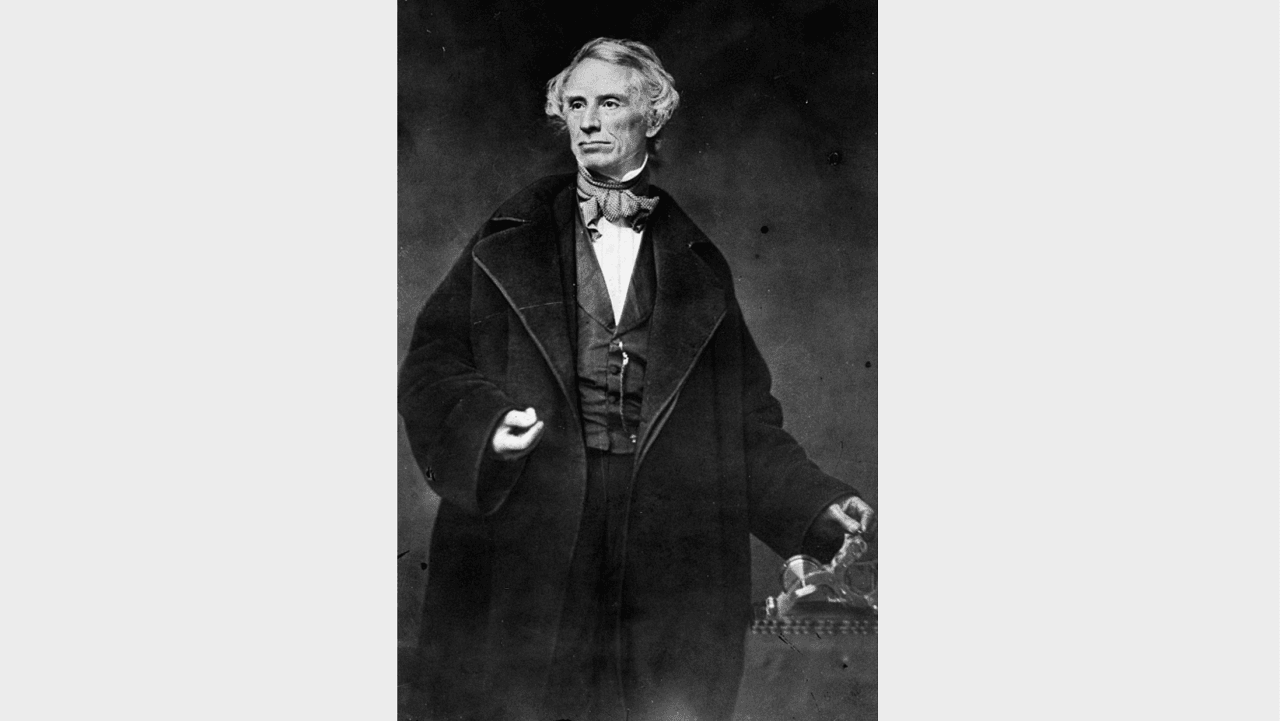
On April 1, 1845, the Post Office Department launched Samuel Morse’s telegraph into the wider world.
There were telegraphs in use before Morse’s invention, but they were optical, transmitting messages visually by way of relay towers. Their operation was limited to daylight hours and clear weather. Morse’s telegraph was electromagnetic, and messages could be sent around the clock — whatever the weather.
In 1843, Congress provided Morse with the funding to test the device’s “practicability and utility … under the direction of the Secretary of the Treasury.”
A telegraph line was built between Baltimore and Washington, DC, and in May 1844, it successfully tapped out its famous first message: “What hath God wrought?”
In March 1845, Congress moved the supervision of the telegraph under Postmaster General Cave Johnson, Morse became an employee of the Post Office Department, and on April 1, the Baltimore-Washington telegraph line was opened to the public.
Though priced at a deliberately low rate, it failed to gain much traction.
Once a fierce skeptic of the device, Johnson became a staunch supporter. He conceded that the revenues of the telegraph would never equal the expense for the Post Office, but by the end of 1845, the telegraph was “an agent vastly superior to any other ever devised by the genius of man for the diffusion of intelligence” and urged that it remain under government control.
The lack of a profit cooled Congress on funding further expansion, however. Morse and his associates struck a deal with Johnson to operate the telegraph in exchange for the profits, at no expense to the Post Office, and later made the same deal with the Magnetic Telegraph Co.
Within a few years, telegraph lines spanned the nation, and the technology caught on —especially with businesses.
The private sector controlled the telegraph network from then on — with one exception: During World War I, President Woodrow Wilson ordered them to be returned to the control of the postmaster general for a brief time.
Add your first comment to this post