
Follow us! >

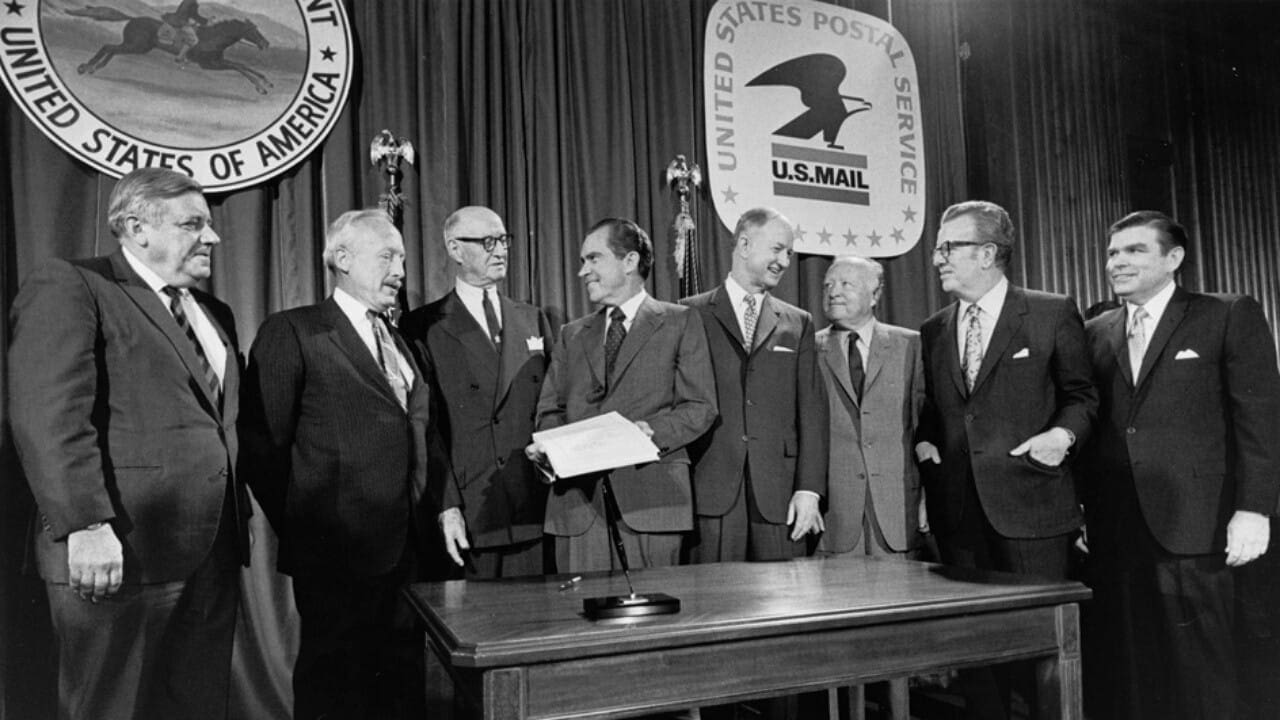
President Nixon signed the Postal Reorganization Act on Aug. 12, 1970

Mere months after a historic wildcat strike brought the U.S. Mail to a standstill, President Richard M. Nixon signed the Postal Reorganization Act— the most comprehensive postal reform since the nation’s founding — on Aug. 12, 1970.

The act abolished the former Post Office Department, a Cabinet-level arm of government funded by taxpayers, and created a unique hybrid entity in its place.

The U.S. Postal Service would be part independent federal agency, part self-supporting business: a government-owned corporation.

The strike that lit the fire for reform paid off. Workers enjoyed the largest pay raise in postal history and won the right to bargain collectively, among other gains.

“We went on strike, and this is what came of it,” said John Magliaro, a letter carrier in Worcester, MA, who was interviewed for the Postal Service’s 50th anniversary oral history project.

“Everybody was happy … we started getting decent money, and the union had more strength,” Magliaro said.

Joshua Dial, a North Carolina District employee development specialist, told the oral history project the establishment of collective bargaining rights was “a very major change — where the employee has a say in working conditions, and even in his compensation. That was really big, really big.”

The law took effect on July 1, 1971, dubbed “National Postal Service Day” by Nixon.

The “History” column appears occasionally in Link.

Sign up to receive our Daily Postal News blast

Related Articles

Tell us what you think below!

Subscribe
Notify of
guest
0 Comments
Oldest
Newest Most Voted
Inline Feedbacks
View all comments

Hot this week

USPS Enforcement of Customs Data Requirements for Military and Diplomatic Mail

Effective March 16, 2026, USPS will engage in enhanced post-acceptance screening efforts to enforce customs declaration form requirements on mail sent to or from addresses at any overseas Military Post Office (MPO) and to or from addresses at any Diplomatic Post Office (DPO).

APWU Policy on EEO, MSPB, and OWCP Representatives

It is the policy of APWU that no union representative is authorized by the national union to represent individual bargaining unit members (or other postal workers) in Equal Employment Opportunity (EEO), Merit Systems Protection Board (MSPB), or Office of Workers’ Compensation Programs (OWCP) matters in their official capacity

Acting USPS processing operations VP named

The Postal Service has named Jason DeChambeau acting processing...

USPS OIG – Grievance Management

Although total grievance payments nationwide trended slightly downward from FYs 2022-2024, some districts and facilities incurred high payment amounts or experienced significant increases in payments.

Postal Service Retirement Crisis: How USPS Broke Career Workers’ Promised Security

On the late 2000s through the early 2020s, the United States Postal Service and Congress approved and enforced retirement and health-benefit policies that fundamentally reshaped how postal retirees would be covered.
spot_img

Related Articles

Popular Categories

Secret Link
0
Would love your thoughts, please comment.x
()
x
Send this to a friend