
The U.S. Postal Service (USPS) is running out of cash. Since 2007, it has posted net losses nearly every year as letter mail, its core revenue source, has fallen by half. It has now hit its statutory borrowing limit, and its leadership has warned that it could be out of cash within the year, save for extraordinary measures. In Washington, the debate is no longer about trimming costs at the margin, but about how deeply to restructure the Postal Service’s operations or overhaul its funding model. Lost in that debate are more basic questions: How big is USPS? And, how much of the economy runs through it?
That reach is a matter of law, not choice. USPS is bound by law to a duty that no private company shares: a Universal Service Obligation (USO) that requires it to deliver to every address, six days per week, at uniform and affordable prices. For millions of households in rural and low-density communities, that guarantee is a lifeline, carrying prescription medications, ballots, online purchases, and the shipments that keep small businesses running.
Any plan to restructure the Postal Service has to reckon with what it actually is: one of the largest institutions in the American economy. Its size reflects what the law requires of it, not how it chooses to run. Where a private company might scale back or drop the routes that lose money, cutting its workforce, shrinking its fleet, and reducing its footprint until it produces a profit; USPS cannot. It’s a public operation required by law to reach every address, and its scale is what meeting that requirement takes.
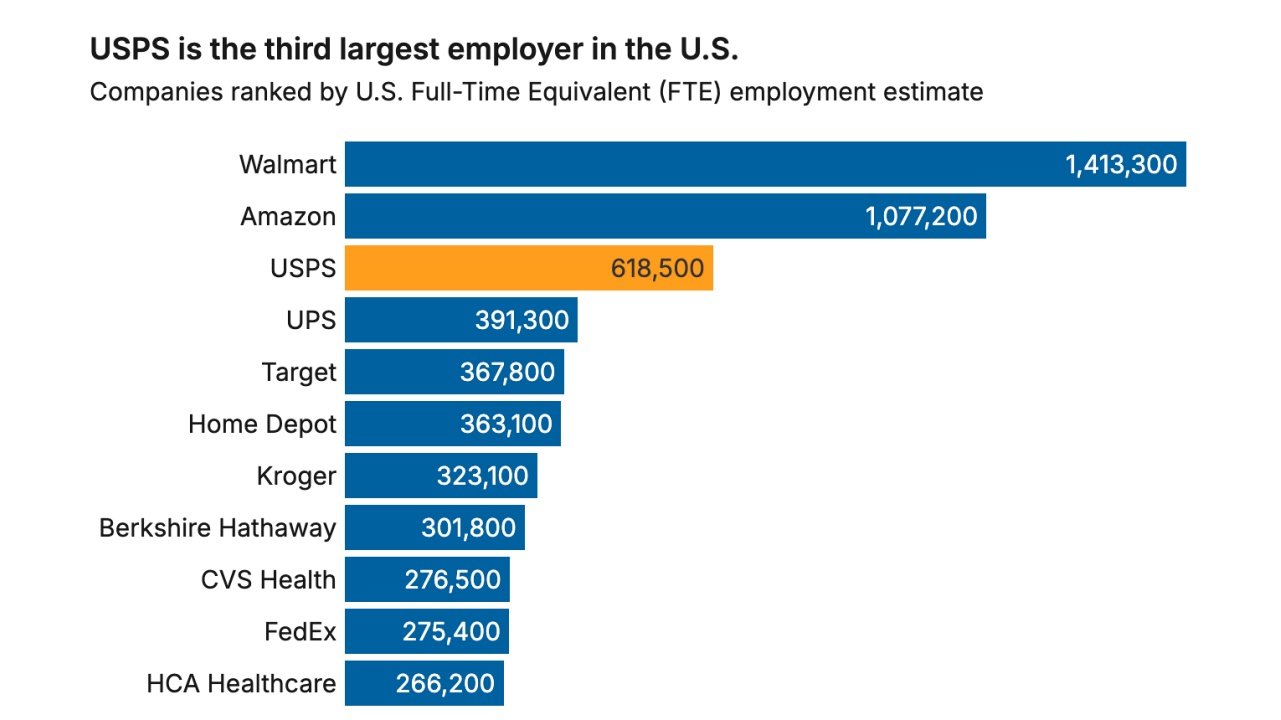
Start with employment. With about 600,000 workers, USPS is the third-largest employer in the United States, behind only Walmart and Amazon (Figure 1). But this ranking undersells what those jobs are and where they sit. Postal jobs offer middle-class pay and federal benefits, often without requiring a college degree, and they have long been a reliable ladder into the middle class, especially for Black Americans. Nearly 30% of postal workers are Black, more than double their share of the national labor force. A workforce of this size means the Postal Service’s finances aren’t only a budget question. They’re also a labor-market question, and the communities with the fewest alternatives have the most at stake.