
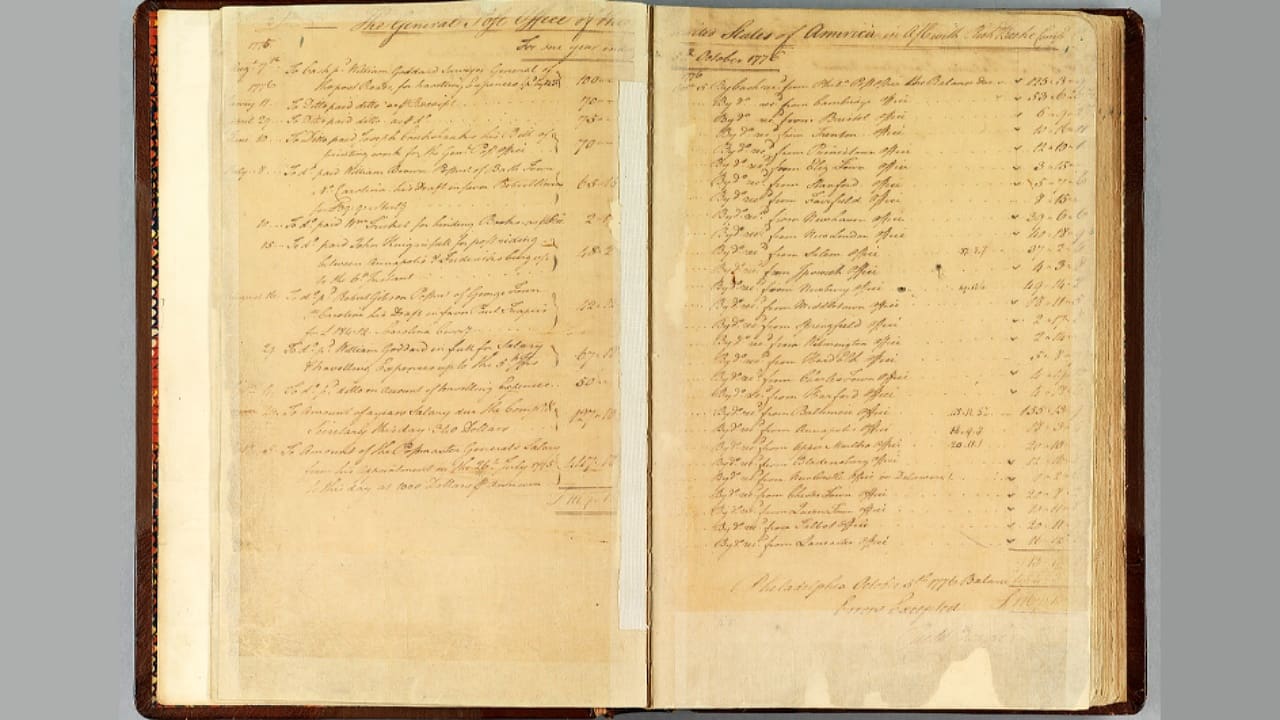
Photo: Postmaster General Benjamin Franklin’s ledger showing income and expenses for the General Post Office as well as local Post Offices from 1776 to 1778.
On Dec. 15, 1836, a quick-moving fire destroyed a large government-owned building in Washington, DC.
The ruinous conflagration is often referred to as the Patent Office Fire, and for good reason: Specifications for nearly 10,000 patents registered between 1790 and mid-1836 went up in flames.
But patents were not the only federal recordkeeping casualty that day. The General Post Office — which is what the Postal Service was called back then — lost important documents, too.
Stephen Kochersperger, the Postal Service’s historian, pointed out that the first 60 years of records relating to postmaster appointments were also destroyed. In many cases, USPS researchers cannot be certain when an early postmaster first took office.
“We instead rely on records of when they made their first financial returns to approximate the date,” he said.
One notable exception: Postal accounts for the years 1776-1778 were saved thanks to a courageous clerk named Cornelius Cox, who risked his life to save Benjamin Franklin’s original ledger.
The destroyed building, once known as Blodgett’s Hotel — although it never served as a hotel — had a fascinating history. The government purchased the unfinished structure in 1810. That year the Patent Office moved in, and the General Post Office followed in 1812. The building even served as a temporary home for Congress after the Capitol was burned by the British in 1814.
The effects of the Patent Office Fire are still being felt at the Postal Service. “The repercussions of that disaster 189 years ago are something we contend with almost daily in our research,” Kochersperger said.
Add your first comment to this post